Pracownia Kuratorstwa
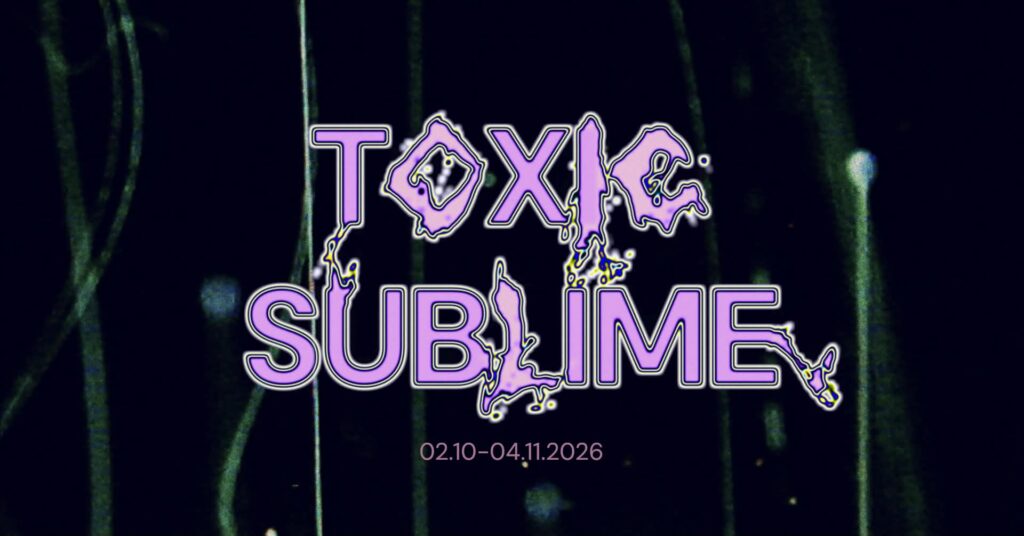
Toxic Sublime
2.10 - 4.11.2026
Curators:
Bartosz Czyżyk, Czarek Wicher, Antoni Żurawski
Some scientific experiments do not end when they should. Over time, the space designated for research begins to operate according to its own rules, and the object of observation gradually takes control of the laboratory. The Rodríguez Foundation becomes the site of just such an experiment. The boundary between the observer and the observed begins to blur. Humans are no longer the sole researchers; they may become part of the process unfolding here, or even feel themselves being tested by other living, evolving entities.
The "sublime" of the title refers to an extraordinary aesthetic experience that combines radically contradictory feelings—such as dread and awe, or pain and pleasure. While the nature of this concept was hotly debated in 18th-century European philosophy by thinkers like Edmund Burke and Immanuel Kant, it continues to intrigue the humanities to this day. Toxic Sublime*, however, represents a form of the sublime suited to our own era—a time when our collective imagination has been enriched by images of bizarre organisms and substances. These have irrevocably altered our concepts of nature, life, and purity.
The toxicity of the sublime is not contained solely within the object we gaze upon. Sulfur-laden fallout coats the compressed blocks of civilizational waste. It ricochets off them, mingling with what life itself has produced over the passage of time. The poisoned Odra River, the Great Pacific Garbage Patch, spectacular satellite images of factories and landfills—all these elements construct an aura of the sublime within these terrifyingly beautiful images of pollution. How toxic, then, must our gaze be—a gaze that follows such images, aestheticizing what is contaminated, filthy, incongruous, and impossible to fully categorize.
Everything begins to breathe. From the outset, the objects appear to be in a state of readiness, as if they might spring into a life of their own at any moment. The exhibition is divided into two zones. In the first, bathed in sterile light, we observe forms that can still be recognized and described. They are accompanied by microscopic footage by Klara Woźniak and dried algae by Piotr Bosacki, framed like biological specimens. In the second zone, a sense of unreality intensifies. Artificial greenery acts as a catalyst, and the entities within it begin to obey their own, indefinable rules. Andrzej Staniek’s glossy, cosmic forms writhe and ooze, eluding clear-cut categorization. This movement is defined by Wiktoria Cwityńska’s aquatic creature, whose body seems to impart its rhythm to the other works.
Toxic Sublime reflects a mode of evolution—accelerated and destabilized by humanity—in which interspecies interactions have come to encompass new realms of existence: imagination, technology, and art. These forms exist both in isolation and in groups, forging connections and weaving themselves into the fabric of everyday life. Each encounter involves a form of intoxication that gives rise to entirely new hybrid and cybernetic species—such as the silicone bodies, endless organisms, and mechanical tentacles gathered in the gallery.
They inhabit a realm of failed experiments, abandoned laboratories, and forgotten lives, where creatures—hibernating and torn from their natural environments—continue to simulate their own existence. They pulse like our sunless viscera; they endure, as if within the space of the Toxic Sublime.
Bartosz Czyżyk, Czarek Wicher, Antoni Żurawski Pracownia Kuratorstwa 2026
*The term "toxic sublime" was originally used by Jennifer Peeples in the article "Toxic Sublime: Imaging Contaminated Landscapes," published in 2011 in the journal “Environmental Communication”.
--------------------------------------------------------------
The exhibition is part of StudioVisit 2026
The exhibition is part of the first edition of the GOSSIP festival, organized by the Stanisław Barańczak Library of Greater Poland.
The Curatorial Workshop (Pracownia Kuratorstwa) is a project initiated by Jagna Domżalska in collaboration with the Rodriguez Foundation (this is its third edition).
Dofinansowano ze środków finansowych Ministra Kultury i Dziedzictwa Narodowego
pochodzących z Funduszu Promocji Kultury.

Dofinansowano ze środków budżetowych Miasta Poznania